Spain is one of the most popular retirement destinations in Europe, attracting expats and pensioners from the UK, the EU, and beyond. A warm climate, high-quality healthcare, a relaxed lifestyle, and relatively affordable living costs make Spain an appealing choice for retirement.
However, retiring to Spain requires careful planning. Residency rules, healthcare access, pension taxation, and cost-of-living differences all play an important role in determining whether Spain is the right long-term option.
This guide explains everything you need to know about retiring in Spain, with a focus on pensions, healthcare, residency, and financial planning.
- Why Retire in Spain?
- Residency Options for Retirees
- Cost of Retiring in Spain
- Healthcare for Retirees in Spain
- Pensions and Taxation in Spain
- Banking and Financial Planning
- Best Places to Retire in Spain
- Advantages and Challenges of Retiring in Spain
- Planning a Successful Retirement in Spain
- Frequently Asked Questions (FAQ)
- 1. What is the minimum income required to retire to Spain?
- 2. Can I work in Spain on a retirement visa (NLV)?
- 3. How long can I stay in Spain without becoming a tax resident?
- 4. How are my foreign pensions taxed in Spain?
- 5. As a retiree, will I get access to Spain’s public healthcare system?
- 6. Do I need to buy property before retiring to Spain?
- 7. What is the typical cost of retiring comfortably in Spain?
Why Retire in Spain?
Many retirees choose Spain for a combination of lifestyle and practical reasons. The country offers a warm climate, scenic landscapes, and a relaxed way of life that promotes social interaction and outdoor activities. From a practical perspective, Spain provides access to high-quality healthcare services, affordable living costs in many regions, and well-established expatriate communities that facilitate integration. These factors collectively contribute to an appealing environment for a comfortable and enjoyable retirement.
Key benefits include:
- A Mediterranean climate with mild winters and abundant sunshine
- A slower pace of life focused on socialising and outdoor living
- A well-regarded public healthcare system
- Affordable private healthcare options
- Lower day-to-day living costs in many regions compared to Northern Europe
- Established expat communities in coastal and urban areas
For many retirees, these factors contribute to improved wellbeing and quality of life.
Residency Options for Retirees
The type of residency required depends on nationality and personal circumstances.
Non-Lucrative Residency (Non-EU Citizens)
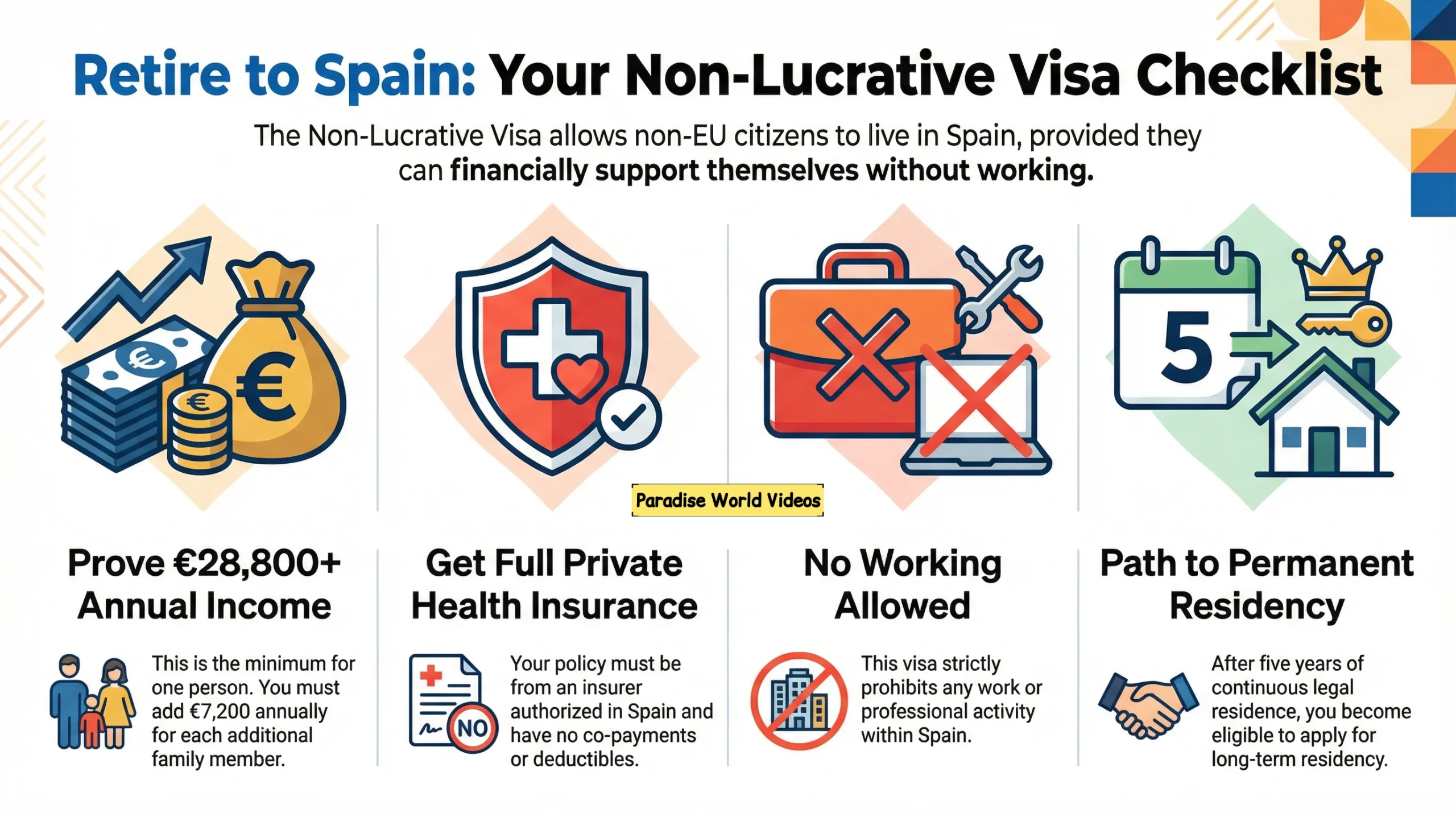
The most common residency route for non-EU retirees is the Non-Lucrative Visa. This visa allows individuals to live in Spain without working.
Applicants must generally demonstrate:
- Sufficient passive income or savings to support themselves
- Private health insurance with full coverage in Spain
- A clean criminal record
- Proof of accommodation
The non-lucrative visa does not permit paid employment in Spain.
EU and EEA Citizens
EU and EEA citizens benefit from freedom of movement but must still register as residents if living in Spain long term. Proof of income, healthcare coverage, and address registration is usually required.
Non-Lucrative Visa (NLV) Financial Requirement
Do not include the main applicant. Enter 0 if applying alone.Minimum Financial Proof Required (Annual)
Annual Required Funds: €28,800
Monthly Equivalent: €2,400
*This is the official minimum required based on the current 2025 IPREM. Consulates may request additional documentation or higher balances.
Cost of Retiring in Spain
Retirement costs vary significantly depending on location and lifestyle.
Typical Monthly Living Costs
Many retirees live comfortably on:
- €1,500 to €2,500 per month in smaller towns or coastal areas
- €2,500 to €3,500+ per month in larger cities or high-demand regions
Costs include housing, utilities, food, transport, healthcare, and leisure.
| Expense Category | Budget Tier 1: Small Town/Inland (€) | Budget Tier 2: Major City/Coastal (€) | Key Difference |
| Housing (Rent 2-BR) | €650 – €950 | €1,200 – €1,800 | Housing is the primary cost variable. |
| Utilities & Internet | €120 – €180 | €150 – €250 | Utility costs are relatively stable. |
| Groceries & Food | €300 – €450 | €400 – €650 | City centers often have higher prices. |
| Transport (Public/Gas) | €50 – €100 | €80 – €150 | Higher reliance on public transport in cities. |
| Healthcare (Private Insurance) | €100 – €200 | €120 – €250 | Varies mainly by age and coverage level. |
| Leisure & Dining | €200 – €400 | €400 – €700 | Leisure spending is higher in cultural hubs. |
| TOTAL MONTHLY ESTIMATE | €1,420 – €2,280 | €2,350 – €3,800 | Targets the "Cost of Retiring" search intent. |
Housing Costs
Housing is usually the largest expense:
- Coastal and popular expat areas tend to be more expensive
- Inland towns often offer better value for larger properties
- Renting is common initially and recommended before buying
Property taxes and community fees should also be considered when budgeting.
Healthcare for Retirees in Spain
Healthcare is a major consideration for retirees.
Public Healthcare
Legal residents who qualify can access Spain’s public healthcare system, which provides comprehensive coverage at low cost. Prescription charges are heavily subsidised.
Private Healthcare
Private healthcare insurance is commonly required for residency applications and may be used alongside public care.
Private insurance:
- Offers faster access to specialists
- Often includes English-speaking services
- Varies in cost depending on age and coverage level
Some long-term residents may later qualify for state healthcare schemes requiring a monthly contribution.
Pensions and Taxation in Spain
Tax Residency
You are generally considered a tax resident in Spain if:
- You spend more than 183 days per year in Spain, or
- Your main economic interests are based in Spain
Tax residents must declare worldwide income in Spain.
How Pensions Are Taxed
Most foreign pensions are taxable in Spain once you become a tax resident. This includes:
- State pensions
- Private pensions
- Occupational pensions
Spain has double taxation agreements with many countries to prevent income being taxed twice. The exact treatment depends on the country of origin and the type of pension.
Professional tax advice is strongly recommended to ensure correct reporting.
Banking and Financial Planning
Retirees should plan finances carefully before moving.
Important considerations include:
- Opening a Spanish bank account
- Understanding reporting requirements for foreign income
- Retaining documentation for pension payments and savings
- Planning currency transfers and exchange rate exposure
Spain has strict financial compliance rules, making transparency essential.
Best Places to Retire in Spain
Spain offers a wide range of retirement locations.
Popular choices include:
- Costa Blanca: Affordable coastal living, strong healthcare access, and established expat communities
- Costa del Sol: Warmer climate and extensive services, generally at higher cost
- Valencia: A balance of city life, beaches, and moderate living costs
- Inland towns: Lower housing costs and quieter lifestyles, with fewer international services
Choosing the right location depends on healthcare needs, budget, and lifestyle preferences.
Advantages and Challenges of Retiring in Spain
Advantages
- Pleasant climate year round
- High-quality healthcare
- Relaxed lifestyle
- Strong social and expat networks
- Relatively affordable living costs in many areas
Challenges
- Bureaucratic processes can be slow
- Language barriers outside expat areas
- Tax and pension rules can be complex
- Regional cost differences require careful research
Understanding both sides helps set realistic expectations.
Planning a Successful Retirement in Spain
A successful retirement in Spain usually involves:
- Understanding residency requirements
- Creating a realistic budget
- Planning pension taxation in advance
- Securing healthcare coverage
- Spending time in different regions before committing
Preparation and flexibility are key to a smooth transition.
Frequently Asked Questions (FAQ)
1. What is the minimum income required to retire to Spain?
The minimum income required depends on your residency route. For the common Non-Lucrative Visa (NLV) route, a single applicant must prove passive income or savings equivalent to 400% of the IPREM (Public Multiple Effects Income Indicator) annually.
As of the latest figures (based on a 2024/2025 IPREM of €7,200), this requirement is approximately €28,800 per year. If you are applying as a couple, you must add an additional 100% IPREM for the spouse (€7,200), totaling €36,000 per year.
2. Can I work in Spain on a retirement visa (NLV)?
No. The Non-Lucrative Visa (NLV) explicitly prohibits the holder from engaging in paid employment or professional activities in Spain. It is intended for financially independent individuals who can support themselves using passive income (pensions, dividends, savings).
3. How long can I stay in Spain without becoming a tax resident?
You become a Spanish tax resident if you spend more than 183 days (six months) in Spain within a single calendar year, or if your primary economic interests are located there. Once you are classified as a tax resident, you must declare your worldwide income (including most foreign pensions) to the Spanish tax authority.
4. How are my foreign pensions taxed in Spain?
Once you are a tax resident, your foreign state, private, and occupational pensions are generally taxable in Spain. Spain has Double Taxation Treaties (DTTs) with many countries (like the UK, US, etc.) to prevent you from being taxed twice on the same income. You should seek advice from a Spanish tax specialist to ensure correct declaration and application of the DTT.
5. As a retiree, will I get access to Spain’s public healthcare system?
Access to public healthcare depends on your status:
- EU/EEA Citizens: Often gain access by presenting an S1 form (for state pensioners) or through contributions to the Spanish system.
- Non-EU Citizens (on NLV): Must purchase private health insurance with comprehensive coverage for their initial residency application. After living in Spain for a period, some long-term residents may qualify to pay into a state scheme called the convenio especial.
6. Do I need to buy property before retiring to Spain?
No. Many retirees choose to rent for the first 6–12 months before committing to a purchase. Renting allows you to experience different regions, neighborhoods, and seasons before making a major financial decision. Proof of accommodation (a rental contract or property deed) is required for most visa applications.
7. What is the typical cost of retiring comfortably in Spain?
The cost varies significantly by location and lifestyle:
- Smaller Towns/Inland Regions: A couple can often live comfortably on €1,500 – €2,500 per month.
- Major Cities (Madrid/Barcelona) or High-Demand Coastal Areas: A comfortable retirement typically starts from €2,500 – €3,800+ per month, with housing being the main driving factor of the higher cost.